
What the Student Sees
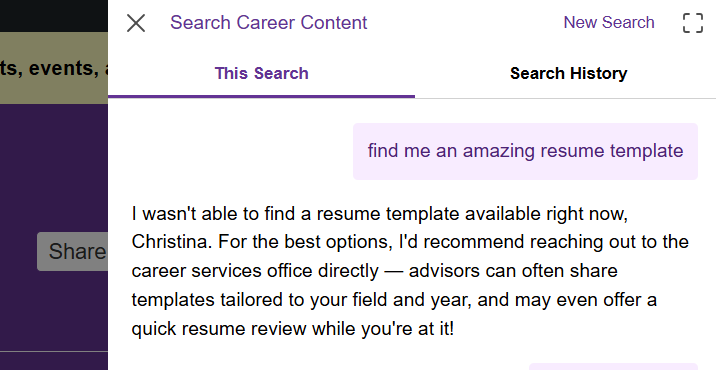
When AI Search cannot find content that meaningfully addresses a student's question, it doesn't return an error or a confusing blank screen. Instead, it responds gracefully — acknowledging that it couldn't find a relevant result and encouraging the student to reach out to career services directly for personalized guidance.
This fallback response is designed to feel helpful rather than deflating. The student learns that the platform couldn't answer this particular question, and they're given a clear next step.
When Fallback Responses Occur
A fallback response can happen for a few different reasons:
- No published content matches the query — The student asked about a topic that simply isn't covered by any content currently on your VCC. This is the most common scenario and the most actionable one for your content strategy.
- Content exists but is SSO-protected — The student is searching as a guest and the relevant content is behind a login wall. In this case, they're encouraged to log in to potentially access more resources.
- The question is out of scope — The student asked about something outside the domain of career services (for example, housing availability or course registration). AI Search is designed to stay in its lane — it will not attempt to answer questions it isn't built to address.
What AI Search Will Not Do
In a fallback situation, AI Search is designed to be honest rather than helpful-sounding:
- It will not fabricate a resource that doesn't exist.
- It will not pull information from the internet to fill a gap.
- It will not surface content a student isn't authorized to see.
- It will not redirect students to content that is unrelated to their question just to return something.
This is an intentional design choice. Accuracy and trust are foundational to AI Search — a response that acknowledges a gap is more valuable than a misleading one.
The Opportunity: Fallback Moments as Content Signals
Here's the reframe that makes fallback responses genuinely useful for your career center team:
|
Every fallback is a content signal. When a student asks a question and AI Search can't find an answer, that's data. It tells you something students are actively looking for that you haven't yet published. A student asking "what do I do if I miss a career fair?" is telling you they want guidance on that scenario. A student asking "are there resources for students interested in climate careers?" is telling you that topic matters to your community. These moments are an invitation to add content. |
As query-level analytics become available in the admin dashboard (see Article 10), you'll be able to systematically identify the topics generating the most fallback responses — making your content strategy increasingly data-informed.
|
Pro Tip: Until query-level analytics are available, pay attention to the questions students bring to your office or ask in advising appointments — those are often the same questions they're typing into AI Search. Use them to guide your content creation priorities. |